A proposal: time to issue a 50-year bond to term out Treasury bills, while the long end is relatively cheap
The US has a shorter average debt maturity than most other OECD countries, and relies more on Treasury bills than its own borrowing advisers recommend. With the curve flat beyond 20 years, an announced, gradual program of issuing 50-year bonds instead of some Treasury bills is relatively cheap insurance against inflation and rollover risk — with the liquidity buybacks as the backstop for leveraged holders, and the Federal Reserve's own Treasury bills as the release valve if short collateral gets tight.
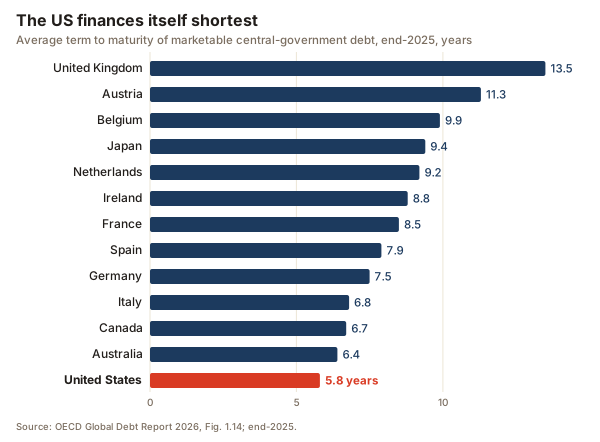
The United States finances itself with shorter-term debt than any other major government. On the OECD's like-for-like measure, the average maturity of US marketable debt was about 5.8 years at the end of 2025 — against 6.8 for Italy, 7.5 for Germany, 8.5 for France, 9.4 for Japan, and 13.5 for the UK. China, outside the OECD measure, finances its central government at about 8.4 years on its bonds—and has issued 50-year bonds since 2009, including in its 2024 ultra-long special bonds. Treasury's own figure agrees: 70 months in July. Treat the Federal Reserve's bond holdings as what they economically are — funded overnight with bank reserves — and the consolidated figure falls to about 4.6 years. More than a fifth of the marketable stock is Treasury bills.
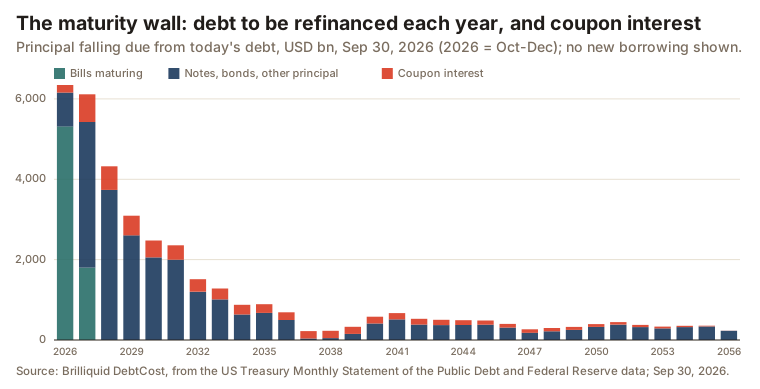
The short maturity is a rollover exposure. This results from active debt management—and it can be managed differently. About a third of the marketable debt — 34.5%, or about $11tn — matures or resets within twelve months; treat the Federal Reserve's holdings as funded overnight, and it is 46%. A sustained 100bp rise in short-term rates would add roughly $110bn a year to the interest bill once that debt has rolled, about $71bn from Treasury bills alone. In an inflation shock, higher short-term funding costs raise the deficit within a year.
A relatively cheap time to extend
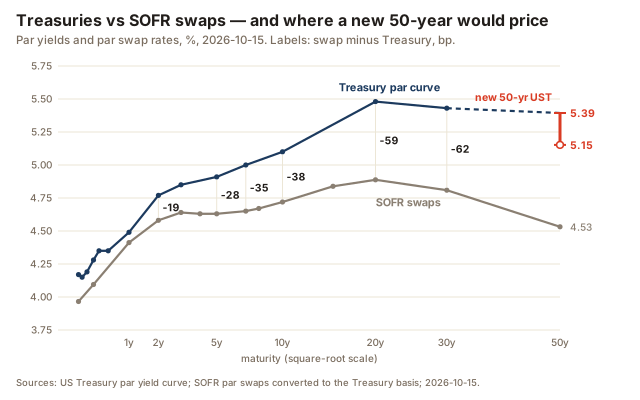
On October 15, the Treasury's par curve put the 20-year at 5.48% and the 30-year at 5.43% — the long end is flat to inverted. Three-month Treasury bills yielded 4.28% — a 115bp gap, below its median of about 175bp since 1990. The 2s30s spread has roughly halved since January, from about 139bp to 66bp. Investors are being paid very little extra to lend for 30 years rather than 2, meaning the government pays little extra to lock in financing for a generation.
The proposal: a 50-year bond, issued instead of Treasury bills
Issue a new 50-year nominal bond on the same schedule as the 30-year's — a new issue at each quarterly refunding and two reopenings — at roughly $100bn a year (about $10bn new, $7.5bn per reopening, a third the size of the current 30-year program). Issue it instead of Treasury bills: the Treasury raises the same cash, and Treasury bill issuance falls dollar for dollar. Cutting notes or bonds instead would not extend the average maturity.
What it costs, on today's curve: Treasury's official curve stops at 30 years, so any 50-year price is an estimate. Mechanically extending the curve puts a new 50-year at about 5.39%; the SOFR swap curve, where 50-year swaps trade 28bp below 30-year swaps, points to about 5.15%. So a 50-year would likely price at or somewhat below the 30-year — roughly 5.15–5.40%, or about 90–110bp above Treasury bills. That is roughly $1bn in the first year per $100bn, rising to around $4.5–5.5bn a year once $500bn is outstanding — if Treasury bill rates stay where they are. The market does not expect them to: it prices short rates about 70–80bp higher over the next two years. On that path the expected cost is closer to $1–3bn a year, and what remains is mostly the term premium — the price of the insurance itself. A first-issue concession, and the new supply itself, could push the price toward the top of that range. What it buys: if inflation pushed Treasury bill rates 300bp higher, that same $500bn would save about $15bn a year in interest. It is insurance, and it pays off if Treasury bill rates average more than about 90–110bp above today's over the bonds' life — only about 20–50bp more than the market already expects. Issuing $100bn in 50-year bonds instead of Treasury bills lengthens the average maturity by about 0.16 years.
The US is not new to this. It sold a 50-year bond in 1911 (the Panama Canal 3% of 1961). The UK, France, Italy, Spain and Belgium all run 50-year lines; Austria, Mexico, Peru and Israel have issued century bonds. Canada issued a 50-year from 2014 for the same reason proposed here — to shift borrowing from short-term to long-term debt and cut refinancing risk — reopening it when conditions suited, then stopped in June 2022 when its borrowing needs fell. Treasury studied 50- and 100-year bonds in 2017, and in 2020 — with 30-year yields near 2% — chose a new 20-year instead.
Is there demand? For duration, plainly yes
A record $522bn of 20-to-30-year Treasury bonds is now held in stripped form — 19.5% of the bucket, about two and a half times the 2017 amount — and the stripped share rises with long yields. Investors are already manufacturing more duration than a coupon bond offers: a 30-year principal STRIP has a duration of about 29 years; a 30-year coupon bond at today's yields has about 15 years. Dealers now take only 10–15% of 20- and 30-year auctions, down from about half in 2009–12; end investors take the rest. For dealers, the concerns that stalled a 50-year in 2017 have eased: at today's yields a new 50-year would carry less duration than a new 30-year did then, end investors now take about 90% of 30-year auctions against 70% in 2017, and since 2024 Treasury's liquidity buybacks support the off-the-run long bonds that a buy-and-hold investor base leaves behind.
At 5.4%, a 50-year coupon bond adds little duration over a 30-year (about 17 years against 15). What it adds that doesn't exist today is a 48-year principal STRIP—new territory for pension and insurance liability hedging. The honest gap: no data can prove demand for maturities beyond 30 years until the instrument exists.
It fits the liquidity buybacks rather than fighting them
Treasury's upsized buybacks are, as we argued in Reading 001, insurance for a levered Treasury complex — and so far Treasury has bought the bonds back cheaper than the on-the-run securities. Since the operations scaled to $4bn-plus in September, the discount on the old 10-to-20-year bonds has fallen from about 15bp to about 10bp: the program is buying a fixed stock of cheap paper faster than it is replenishing it. The discount itself is normal — off-the-runs always trade cheap to on-the-runs. The buyback program insures against the moment they stop trading altogether: in stress, when dealers cannot absorb them, forced sellers turn to the on-the-runs and futures instead, and yields jump across the curve, as in March 2020. A standing buyer for the old bonds keeps that pressure from spreading to the benchmarks.
In practice, the buybacks are financed with bills, so they shorten the debt — TBAC's own analysis assumes as much, and its members have suggested that larger programs could be funded with coupons instead. A 50-year does exactly that: at about $100bn a year, it roughly replaces what the buybacks take out of the long end, and anything issued beyond that lengthens the debt.
Why it matters
Three tools, three risks: the 50-year for inflation and rollover risk, the Federal Reserve's Treasury bills for collateral scarcity, the buybacks for a disorderly unwind.
None of this needs to surprise the market. Treasury's own borrowing advisers have recommended keeping Treasury bills at around 15 to 20% of the debt; Treasury's baseline has them at 22.2% (July). Issuing the 50-year instead of Treasury bills moves the debt back toward that range. The shift does lean on leveraged holders at the margin — more duration to absorb and, if Treasury bills become scarce, less money-like collateral — and that is a reasonable outcome if it is gradual and announced. Treasury has done this before: it announced the 20-year's return in January 2020 and first auctioned it in May. Announce the program at a refunding, start small, publish the path for the bill share and the 50-year's size, and keep the liquidity buybacks in place as the backstop. If short collateral does get tight, the Federal Reserve holds $560bn of Treasury bills (September, up from $234bn at end-2025) — about five years of a $100bn-a-year shift. It can slow purchases or let them run off to private hands at a pace that doesn't drain bank reserves too quickly, without any coordination with Treasury. Leveraged holders get time to reposition, and over time more of the long end sits with the pension and insurance hedgers the STRIPS market says want it.
Treasury's dealer questionnaire for the November 4, 2026, refunding asks about structural demand and future auction sizes across the curve, and about the larger buybacks — but not about anything beyond 30 years. That leaves the more useful question open: not whether to hold long yields down, but whether to lock them in — while the long end is this flat and the US is this short.
Methods and sources available upon request.
This describes debt-management mechanics and costs on stated assumptions. It is not a forecast and not a recommendation on any security.
Public sources: OECD Global Debt Report 2026; US Treasury (par yield curves, auction and buyback results, Monthly Statement of the Public Debt, refunding and TBAC documents); Federal Reserve (SOMA holdings); TreasuryDirect FedInvest prices; SOFR swap rates; national debt-management offices. Full methods and sources available upon request.
Costs and payoffs are arithmetic on stated assumptions, not forecasts.
Disclaimer: This post is for informational and educational purposes only and does not constitute investment advice or a recommendation to buy or sell any security. Securities services through Weild & Co., member FINRA/SIPC.