What can global capital markets contribute to international peace and prosperity?
How escrow, vesting securities and forfeiture can make peace terms hold: a design sketch for returning sanctioned energy to the world market through one licensed channel, only while negotiated peace agreements are upheld.
When I started my career in finance and capital markets, I, along with many others, believed we could change the world for the better. This Reading puts that belief to a hard, current real-world test. What can global capital markets contribute to ending wars, and ensuring that a durable peace and prosperity follow?
Problem overview
Peace settlements fail less often for want of proposals, or even terms, than for want of trust that the terms will be kept.
US capital markets are the envy of the world because the institution — the market for US government debt and the dollar reserve currency — allows savers everywhere in the world to hold US dollar assets, not because they are made to, but because the market is the deepest, its settlement the most reliable, and its rules the most predictable: contracts are enforced, the plumbing works under stress, and the terms do not change with the counterparty. In other words, the power of the capital market comes from the trust in commitments, that dollars and Treasuries are a safe asset, that investors can hold when everything else is in doubt. It is a judgment that others make, not one the country can declare.
This Reading sketches one way to put capital markets to work to support durable peace and end three wars: Russia's in Ukraine, the war around Iran and the Strait of Hormuz, and Gaza. The program would return sanctioned energy resources to the world market through a single channel, licensed by the US Treasury's Office of Foreign Assets Control (OFAC). Buyers of energy in this channel can pay with Treasuries they already hold. Producers receive payment against delivery based on market prices, initially enough to cover their costs and part of their margin. The balance is held for the producer as restricted Treasury notes, its stake in the peace, which vests only while the peace holds. Economic development goes hand in hand with the negotiated peace. The program's second part, a Reconstruction and Development Fund (the Fund), is seeded by a small levy on the exports of the world’s major producers.
The United States would anchor it but cannot run it alone, and does not control the market it opens. What it can do is move first, and move now. The rails are American; the buyers, the gas law, the guarantees and most of the money are not. Approval by Congress is what makes the terms credible to the other parties, because it makes them much harder for later governments to undo.
The program exists only as part of settlements in Ukraine and around Iran and the Strait of Hormuz. It does not wait for a Gaza settlement; it carries Gaza through those two: Iran's stake vests only as the armed groups it backs stand down, and the Fund pays for Gaza's relief and rebuilding. The program supplies instruments; any peace settlement still needs to set them. How fast stakes vest, when the levy begins for each producer, how claims for war damage are handled, whether a bloc admits restricted pipeline gas, the size of pledges and the currency of settlement are all choices for the parties, within the program's limits. That is deliberate: the program does not negotiate the peace terms. It makes whatever terms are agreed more likely to hold.
Why peace proposals fail
The wars of the past four years have produced dozens of peace proposals. Read together, the proposals stumble at three recurring hurdles more than at disagreements over terms:
- Enforcement. Neither side believes the other will keep its word once the pressure eases.
- Who moves first. Each side's first step is the other's precondition, so no one moves.
- Money that never arrives. Pledges for reconstruction are announced at conferences and disbursed slowly, if at all.
None of these is a drafting problem. All three are problems that financial contracts were invented to solve.
Energy as a separate basket. Earlier proposals put sanctions relief inside the political package, one bargaining chip among many. The program takes energy out as a basket of its own and makes it the implementation path: the peace settlement's terms are negotiated with each party's own levers, and the energy basket makes keeping them pay, for every side.
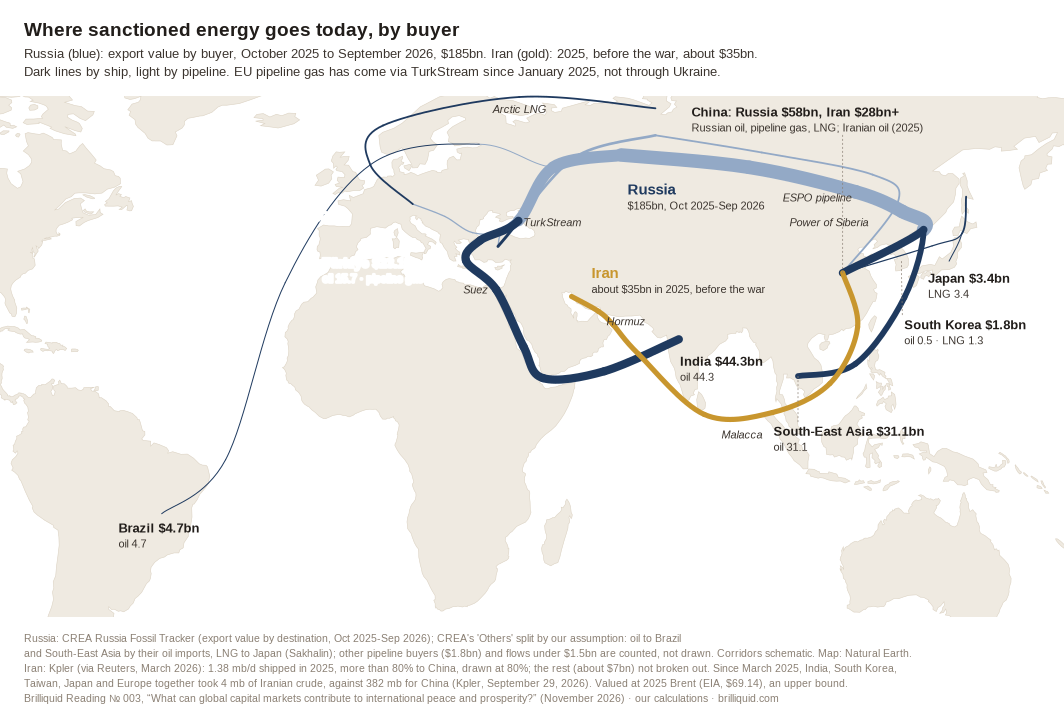
The map below shows where sanctioned energy goes today, by buyer.
What markets can do that diplomacy cannot
A bond market is, among other things, a machine for making promises credible between parties who do not trust each other. Three of its ordinary tools map directly onto the hurdles above.
- Escrow funded before signing answers the money that never arrives. The payment is held in custody before anyone is asked to move.
- Securities that vest milestone by milestone answers who moves first. No one has to move first on everything; each verified step releases its own tranche, and a missed step pauses only its own.
- Forfeiture to a third party answers enforcement. A producer that breaks the peace loses its unvested stake to a Fund for the people the war harmed. The stake never reverts to the US Treasury, so the United States can never gain by declaring a breach, and that is what makes the stake credible to the producer.
There is a precedent for using US government securities as an instrument of settlement. In 1974, US Treasury Secretary, William E. Simon, previously the Salomon Brothers senior partner in charge of its Government Bond and Municipal Bond Departments, the firm I joined years later, traveled to the Gulf to secure a commitment from oil exporters to place their new surpluses in US government securities; oil money was recycled into Treasuries and into building the exporters' own industry. The program sketched here runs the other way. Countries holding government bonds from past surpluses use them to buy energy legally; the producers end up holding those bonds, on condition that the peace holds; and the buyers' savings on cheaper energy are invested at home and in rebuilding.
The program, end to end
The diagram below follows one delivery through the system. Every part is an existing kind of institution: government securities, custody at a central bank, a sanctions license, an independent trustee, an arbitration panel.
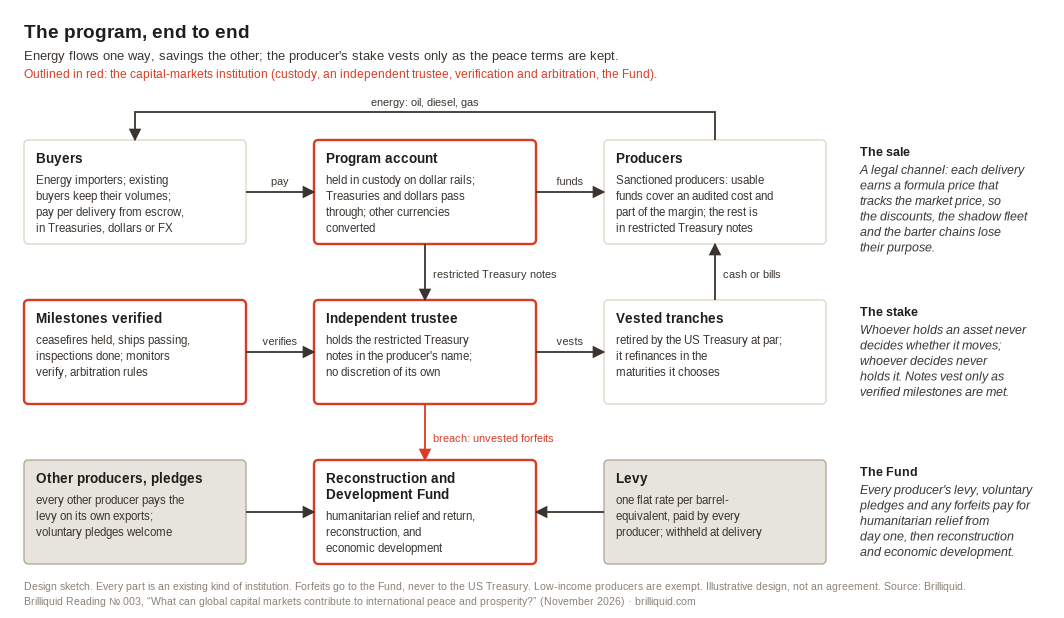 Three ways to pay, one instrument to receive. A buyer can pay for future deliveries with US government bonds it
already holds, with dollars, or with its own currency where capital controls allow. In practice the bonds are a
country's reserves: its central bank, acting as agent, places them in escrow for its importers, who pay it in their own
currency, much as one large importer's central bank has sold its state refiners their entire daily dollar needs
from reserves since October. Where no central bank does,
importers pay in dollars. Whatever the route, the producer receives the same thing. No buyer has to sell bonds into the market to take part: bonds are taken in at delivery, and
what reaches the market is short-dated bills, in small amounts, on a schedule announced in advance.
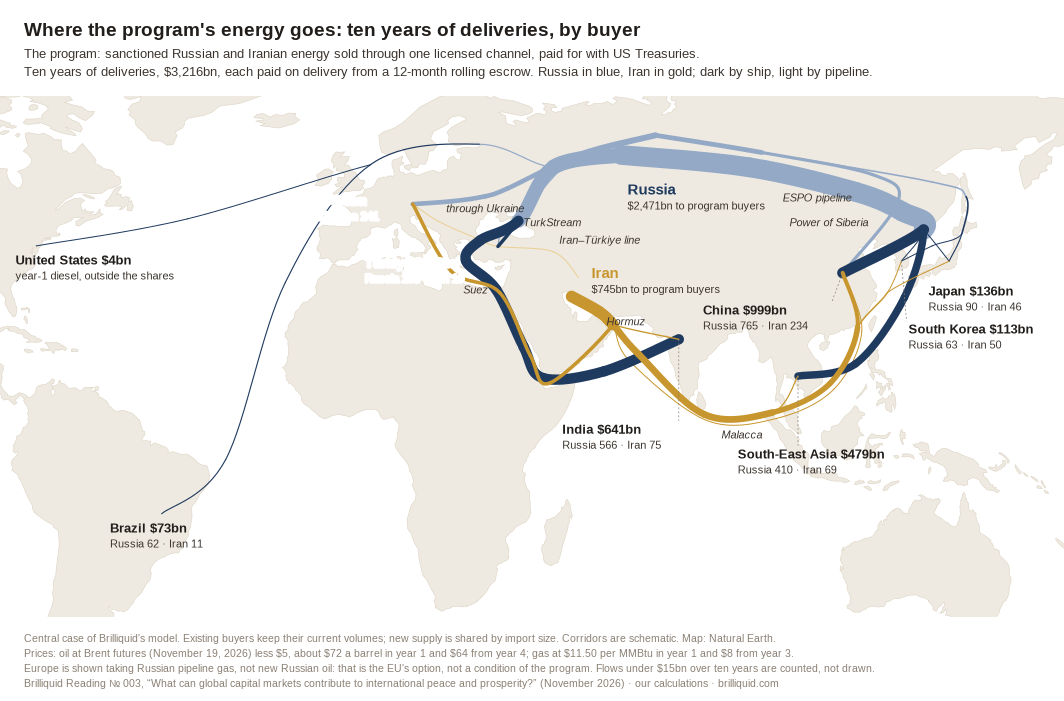
Price and escrow. Each delivery is priced by a formula the parties agree at signing: an average of physical benchmarks (dated Brent and Dubai/Oman for oil) over a window that starts some months later, so producers are not paid a wartime price for peacetime oil, with a floor that always covers the audited cost and the levy. Nothing is paid up front. Each buyer keeps a rolling escrow with the trustee equal to the next twelve months of expected deliveries and tops it up as it is drawn; the assets stay the buyer's, earning its interest, until each cargo is delivered. The ten-year totals on the program map below are paid that way, delivery by delivery.
What the producer receives. On each delivery the producer is paid enough usable money to cover an audited cost of production and part of the margin. The rest of the margin is paid in restricted notes: non-marketable, floating at the short-term bill rate, held by the trustee in the producer's name. They carry no interest-rate risk for either side, and they cost the US Treasury about what the short-term borrowing they replace would cost.
How the stake vests. Each tranche vests slowly at first and faster once a period passes with no breach. Milestones are measured, not declared: ceasefires held, shipping passing without interdiction, inspections completed. A missed milestone pauses its tranche; an arbitration ruling after notice and cure forfeits the unvested stake; a continuing breach suspends the license.
One barrel, in numbers. Take a $70 barrel with an illustrative audited cost of $40. The producer is paid the $40 at once, $5 goes to the Fund as the levy, and the $25 margin is split: on today's export volumes, $12.50 in cash and $12.50 in restricted notes; on any volume growth, all $25 in notes. In the study's central case a tranche vests after three clean years and the rest over the following ten. The buyer's Treasuries are not sold: they become the producer's restricted notes, and the US Treasury retires each vested tranche at par and refinances it, so the notes add no new US debt.
Who holds what. Whoever holds an asset never decides whether it moves, whoever decides never holds it, and the US Treasury does neither. The custodian moves nothing except on the trustee's instruction; the trustee has no discretion of its own; the arbitration panel rules within fixed times; Congress approves the terms, which makes them much harder for later governments to undo. A breach is ruled by five arbitrators with a neutral majority, on a case any signatory can bring; only the party ruled to have broken the terms loses anything, and a missed milestone is not a breach. A board of guarantors, including the states that mediated the talks, appoints and oversees the trustee. For parties whose reserves have been frozen, trust in US securities has to be earned again; that is why the stake sits with an independent trustee and can only ever go to the Fund.
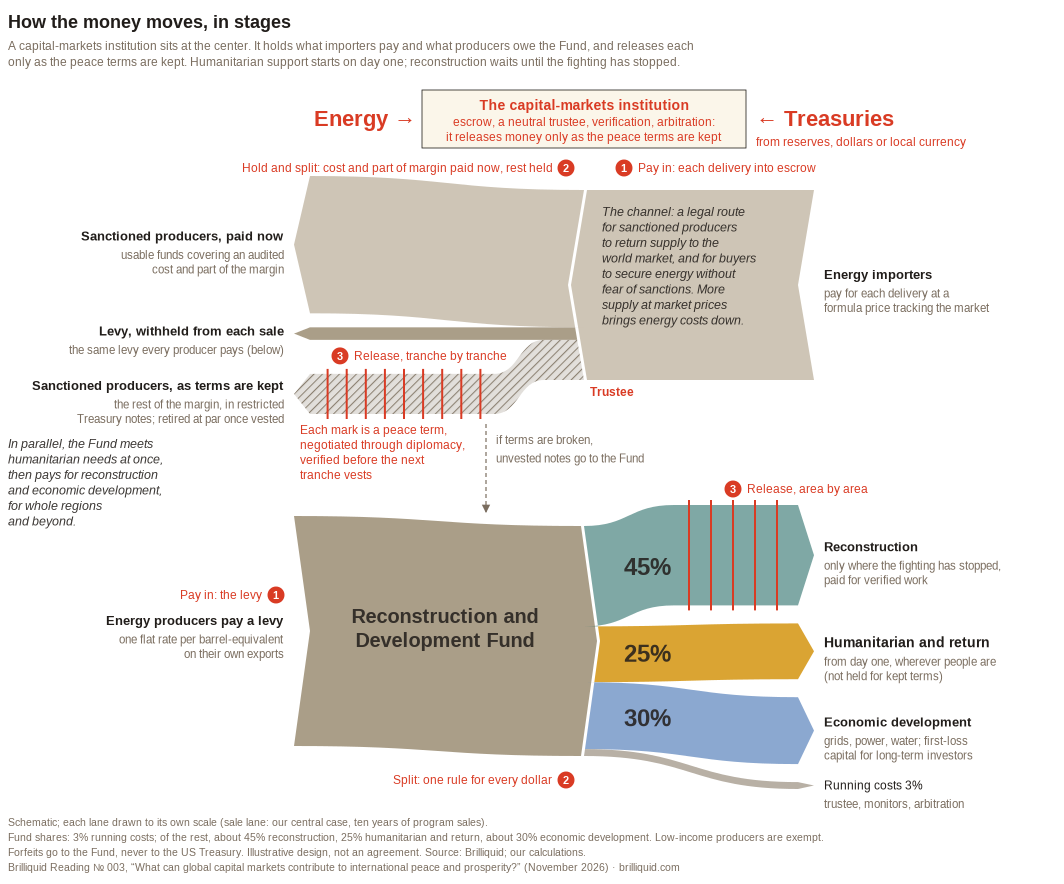
The levy. Every producer of oil and gas except the lowest-income pays the same levy, $5 per barrel-equivalent, on its own exports into the Fund. The United States, which cannot tax its own exports, pays an equal amount from its budget. Because the levy applies to every barrel traded, most of it reaches buyers through the price (more on this below), so it asks little of producers that did not fight, and buys them a calmer market and safer sea lanes. The Fund's base case counts the levy and that US payment alone; voluntary pledges would come on top. The Fund divides every dollar it receives the same way: 3% for its running costs; of the rest, about 45% for reconstruction, 25% for humanitarian relief and the return of the displaced, and about 30% for development (grids, power, water), always against verified work. The order matters as much as the splits. Humanitarian support goes wherever people are, from the start. Reconstruction is paid only where the fighting has stopped; the condition attaches to areas, never to people, so in Gaza humanitarian aid flows from the first day and rebuilding follows area by area as each is certified safe. The producer's own restricted Treasury notes vest on verified terms too.
Decided and run on the ground. The hardest work on a settlement starts once it is signed. The Fund works through regional committees, one for each region the wars hit, which should identify implementing partners and a pipeline of projects before signing, beginning with mine clearance, where capacity can be built now. The Fund keeps its people and its decisions close to the work. These teams live where the work is, hire locally wherever they can and hold delegated authority, within limits the regional committees set, to approve projects and release payment against verified work without waiting on a distant board. The separation of powers stays: the team decides within its limit, the trustee moves the money, and an independent auditor checks both.
The next diagram follows the money in those stages: what is paid at once, what waits on kept terms, and how the Fund divides the levy.
 The map below draws the same flows at the same scale per year, with the program in place: ten years of deliveries settled through the channel, by buyer, at oil futures prices less $5. It shows gas to Europe on both routes, through Ukraine and TurkStream, if the EU chooses to take it, and a small first-year diesel purchase by the United States.
Recycling surpluses without selling them
The persistent current-account surpluses of the largest exporters have for decades been recycled into the debt of the largest deficit country. That flow kept deficits easy to fund and the reserve currency strong; it is also the counterpart of imbalances that many finance ministries now describe as a drag on growth and a source of risk, including the risk of a disorderly adjustment through financial markets.
The program gives surplus savings a use other than buying more government debt, and an orderly one. Holders spend reserves on energy without selling them into the market. The money then flows into energy, reconstruction and power investment, settled in dollars, on dollar rails.
One effect runs the other way and should be stated plainly: cheaper energy lowers importers' fuel bills and so widens their surpluses. The levy answers most of it. It is written as a charge on producers, but who bears a tax depends on the market, not on who writes the check. A levy on every producer's exports, at one rate, leaves buyers no untaxed barrel to switch to, so it is largely carried into the price that buyers pay. Buyers still pay less than they would without the program, but part of what they save is collected at delivery and spent on reconstruction and development: on the study's central assumption about prices, about half. In effect the levy recycles a share of the importers' gains by design, into investment in the places the wars damaged, rather than leaving it to accumulate as reserves.
What remains changes where the surpluses go more than how large they are, and narrows imbalances gradually.
Prosperity? With peace everyone wins
Peace opens the door to cultural exchange, trade, and shared knowledge across civilizations. The Fund is no-fault: it is paid by a levy on energy exports, not by reparations from one side, and it settles no claims. Compensation for war damage remains for the settlements, and Europe's immobilized Russian reserves stay outside the program. The Fund pays for reconstruction where the need is, and for economic development: the move from war to peace, and from economies that depend on raw energy exports to broader growth: grids, power, water, efficiency and new industry, in the producers' economies and their neighbors'. These are investments that pay for themselves. Peace comes first because development builds on it. Trade, investment and the long work on imbalances and economic development all assume it. Amartya Sen treats development as the expansion of the freedoms people have reason to value, and among them he lists the opportunity "to live in peaceful and crime-free communities".
What peace ends. The cost of these wars is counted in lives first. By the available estimates, these wars have cost close to a million lives, though wartime figures are inherently difficult to confirm. The UN refugee agency counted 117.8 million people forcibly displaced worldwide at the end of 2025, 41.6 million of them refugees. The World Bank and the UN put the damage and reconstruction needs in the places the wars have hit at more than a trillion dollars.
Clear the ground first. Within each place's reconstruction share, the first call is clearing mines and other explosive hazards, because nothing else can safely be rebuilt, farmed or returned to until that is done. The same applies to shipping lanes at sea.
Cheap and secure energy. Growth needs cheap energy, from whatever source. Returning sanctioned supply to the market through a licensed channel adds supply, and added supply lowers prices; the size of that effect is an assumption of any program like this, not a measurement. Cheaper energy acts on inflation and on the cost of government borrowing at once, which few other levers do. Security of supply is built into the program. A producer that cuts deliveries to coerce a buyer misses a milestone and pauses the vesting of its own tranche; a producer that breaks the peace forfeits it. Whether Europe takes Russian pipeline gas at all is the EU's choice, not a condition of the program. If it does, the gas comes inside the settlement's security guarantees, and the Fund's development spending gives priority to resilient infrastructure (grids, interconnectors, storage) so that no buyer depends on a single supplier again. Open access, at a published formula price, keeps the channel a market rather than a cartel.
What the money can start. A levy of $5 on every exported barrel of oil equivalent raises, in the study's central case, about $1.2 trillion over ten years for reconstruction, humanitarian relief and economic development. It is an anchor, not the whole bill. Paid as first-loss capital, the development share lets pension funds, sovereign funds, development banks and private capital invest alongside it on commercial terms. The evidence on how far that stretches is mixed, so a fair working figure is total investment of about twice the Fund's own size over its ten years: an assumption to test, not a promise.
Costs that fall on the neighbors. Russia and Iran sit on Europe's doorstep, and wars without end there do not stay there. Their costs are paid far from the fighting: in Europe's energy bills, in shipping through the Gulf and the Red Sea, in the import bills of economies from Türkiye to South-East Asia, and in the growth of everyone in between. The program aims to reverse that: to stop pushing the costs outward and to seed development across the whole region instead. The two regions the Fund serves, Eurasia and the Middle East, are home to about 790 million people (World Bank, 2025). That is a development task on the scale of China's after 2001, when about 610 million people were lifted out of extreme poverty in under two decades (World Bank).
Economic Development at Scale — not a forecast. In 2008, Russia and its neighbor, Poland, that had joined the European Union four years earlier had incomes per head within about a tenth of each other. By 2025, Poland's was two-thirds higher (World Bank). Counted on today's population, the gap is worth about one trillion dollars a year. Isolation is not the only cause, but it is the one a peace agreement can change. In the Middle East the pattern repeats: in 2008, Iran had about three-fifths the income per head of Türkiye, with a similar population; by 2025, after years under sanctions, it had about a third, while Türkiye nearly doubled. The smaller war-damaged economies start from an even lower base: Ukraine's income per head now stands below where Poland stood in 1995, and Poland has since more than tripled its income per head on an open, market path. If these economies reached their neighbors' income per head today, the gain would be measured in trillions of dollars a year, not in the price of a barrel. The wider lens shows more of the same. Since 2008 the euro area has slipped from 63% of US income per head to 56%; had it held its 2008 position, its output today would be about $1.6 trillion a year higher, by our calculations. The US has outgrown the euro area after every shock, the financial crisis and COVID-19 among them (Robin Brooks, Brookings), and the loss of cheap Russian energy added to it. That too is an illustration of scale, not an attribution: most of that gap has causes no peace settlement can touch. Europe lost most of its pipeline gas from Russia after 2021 and paid, by our calculations, about $740 billion more for its gas imports since 2022 than at its 2018–19 price, more than $400 billion of it in 2022: an order of magnitude, not an invoice, and not all of it from one war.
From pipeline of projects to public markets. The final step has the most long-lasting impact. Projects begun with first-loss money become companies, and companies that mature can list on local and regional stock exchanges. Outside the United States, equity markets are relatively small compared to the global savings looking for opportunities, so cap-weighted benchmarks keep sending those savings to the same few stocks. A pipeline of investable companies in the regions that need capital, listed on venues open to investors from abroad, gives the savings somewhere else to go. Stronger regional capital-market infrastructure makes that development more resilient. It is the slow route by which surpluses stop flowing in one direction.
Who has to say yes
No one party can make the program work, but one can start it. The United States holds the gate, and that gives it the initiative: by putting the channel on the table now, with the license, the notes and a statute ready, it can bring buyers, guarantors and investors to the table before the settlements are signed. That gives the negotiators a reason to finish sooner, because each side would know that keeping its word pays from the first delivery. The peace terms remain the parties' own, and the program succeeds only as other nations commit:
- The peace terms, and keeping them: The parties to each settlement
- Buyers for the channel: The large energy importers, whose existing purchases continue through the channel
- Changes to their own energy law, where needed: Importing blocs that restricted sanctioned supply
- Long-term guarantees: A board of guarantors, including the states that mediated the talks, on which no member decides alone
- Senior capital for rebuilding and development: Sovereign funds, pension funds, development banks and private investors
- Enforcement beyond national law: A UN Security Council resolution, on top of the US statute
- The license, the restricted notes, custody and a statute: The United States: the US Treasury, the Federal Reserve Bank of New York and Congress
Money alone does not bring the largest energy buyers in; the terms do, and they cost little: enforcement under a UN Security Council resolution, a written safe harbor from secondary sanctions, current volumes kept, and settlement in their own currency where capital controls allow. The largest buyers of sanctioned oil now get it at a discount, which the channel's formula price ends. What they gain instead is lawful supply at volume, the safe harbor, a use for reserves they already hold, and lower prices on everything else they buy; whether that outweighs the discount is their judgment. Once the large buyers commit, a producer's calculation turns; the buyers, more than the producers, decide whether the channel works.
What it rests on
- Not every party gains on energy. Lower prices help importers and cost exporters, some of whose agreement the program needs; their reasons to join are security and stability, and cannot be assumed.
- Two assumptions, to be tested across a range. How far added supply lowers prices, and how much private capital first-loss money attracts at this scale.
- Verification and arbitration. Monitors the parties accept; one panel trusted to rule on time.
- A pause, not a peace? Some observers argue that Iran's rulers would sign only to treat the settlement as a pause before the next round. Even so, narrow terms that ask for verifiable conduct, not a change of regime or creed, are the kind most likely to be signed and checked, and the program asks only for those. It cannot stop a government that chooses war, but it makes that choice cost the unearned stake, and gives the parties a standing forum, the arbitration panel.
- Durability. A legislature binds its successors only as far as they choose to be bound.
None of these is unique to this program. What capital markets add is money in escrow behind the commitments before signing, so keeping them is worth more than breaking them.
Public sources: CREA Russia Fossil Tracker; Kpler; World Bank (World Development Indicators, damage and needs assessments); UNHCR Global Trends; Kiel Institute; EIA; Meduza and Mediazona; national statistics. Full methods and sources available upon request.
This design sketch, drawn from a longer study, is not a proposal by or on behalf of any government. Figures are arithmetic on stated assumptions, not forecasts.
Disclaimer: This post is for informational and educational purposes only and does not constitute investment advice or a recommendation to buy or sell any security. Securities services through Weild & Co., member FINRA/SIPC.